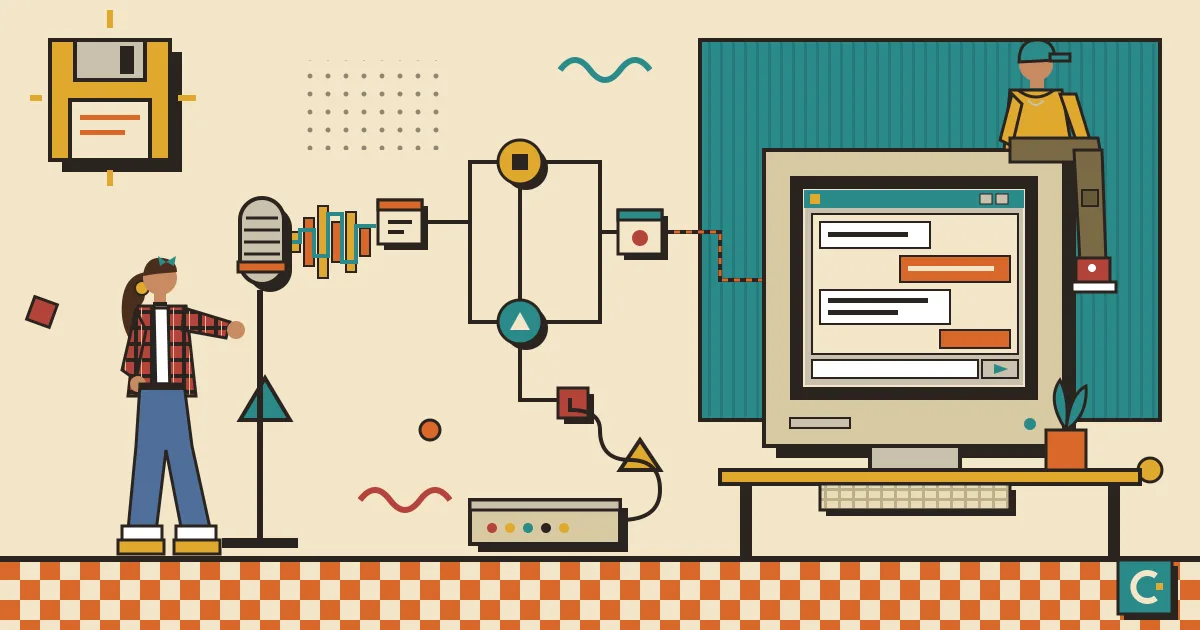
Models keep getting better. Is your agent actually being used?
On July 15, 2025, Mistral AI announced Voxtral, a family of open speech understanding models. The announcement opens with a strong idea: voice was humanity's first interface, and it is coming back as the most natural way to interact with machines.
If you build AI agents on Make.com, n8n, Zapier or a custom stack, that should get your attention. It confirms a trend you already feel: the AI "engine" is getting cheaper, more capable and easier to reach every month.
Yet many builders hit the same wall. The workflow runs. The prompts are tuned. The model is excellent. But the agent sits in a backend, triggered by webhooks, and the people it was built for (customers, colleagues, clients) have no clean way to talk to it.
This article looks at what Voxtral changes for agent builders, and why the real bottleneck has moved from the model to the interface. It also shows how Chat4Agent fills that gap for no-coders, developers and agencies.
Source: "Voxtral", Mistral AI announcement, published July 15, 2025.
What Mistral announced, in plain terms
According to Mistral, until recently teams that wanted speech intelligence in production had two imperfect options:
- Open-source speech recognition with high error rates and limited understanding of meaning
- Closed, proprietary APIs with strong transcription and understanding, but at a higher cost and with less control over deployment
Voxtral is presented as a way out of that trade-off. Here is what Mistral says the models offer:
- Two sizes: a 24B model for production-scale applications and a 3B "Mini" model for local and edge deployments, both released under the Apache 2.0 license and also available through Mistral's API
- Long context: a 32k token context window that handles audio up to 30 minutes for transcription or 40 minutes for understanding
- Built-in Q&A and summarization: you can ask questions about audio or generate structured summaries without chaining a separate speech recognition model and a language model
- Native multilingual support: automatic language detection and strong performance in widely used languages such as English, Spanish, French, Portuguese, Hindi, German, Dutch and Italian
- Function calling straight from voice: spoken intents can trigger backend functions, workflows or API calls directly
- Text capabilities preserved: the models keep the text skills of their backbone, Mistral Small 3.1
On pricing and performance, Mistral states that Voxtral Mini Transcribe outperforms OpenAI Whisper for less than half the price, and that Voxtral Small matches ElevenLabs Scribe, also for less than half the price. API pricing starts at $0.001 per minute. The models can be downloaded from Hugging Face, called through the API, or tried in Le Chat's voice mode.
Mistral also lists enterprise options (private deployment, domain-specific fine-tuning, dedicated integration support) and upcoming features such as speaker segmentation, word-level timestamps and non-speech audio recognition.
The point that matters for agent builders: function calling meets workflows
One line in the announcement deserves special attention from anyone who automates: function calling from voice that triggers workflows or API calls.
That is exactly the territory of Make.com scenarios, n8n workflows and Zapier Zaps. Mistral is describing a future where a user says what they want, and the system turns that intent into an action: create a ticket, update a CRM record, send a quote, search a knowledge base.
The logic you already build in your automation tools becomes the "hands" of the agent. Models like Voxtral become the "ears and brain". But there's a third piece that no model release provides: the place where the user actually meets the agent.
The hidden cost of skipping the interface
When a model gets cheaper and better, it's tempting to think the hard part is solved. In practice, agent projects stall for reasons that have nothing to do with word error rates.
1. The agent stays invisible
An n8n workflow with an AI node is powerful, but your end user can't open n8n. Without a front end, the agent is only usable by the person who built it. Every demo becomes "let me share my screen".
2. Custom front ends eat the budget
The classic fix is to build a chat UI from scratch: authentication, conversation history, responsive design, branding, hosting, maintenance. For a developer, that's days or weeks that don't improve the agent's intelligence at all. For a no-coder, it's often simply out of reach.
3. Makeshift interfaces hurt trust
A generic widget, a shared form, a Slack bot glued together at the last minute: these work for internal tests, but they don't feel professional. When an agent represents a business in front of customers, a clumsy interface makes even a brilliant model look unreliable.
4. Agencies can't scale delivery
For agencies, every client agent that needs a bespoke interface is a mini software project. Margins shrink, timelines slip, and the AI service becomes hard to sell repeatedly.
The irony is clear. Mistral's announcement is about making speech intelligence accessible and controllable at scale. If your agent can't be reached by real users, none of that accessibility reaches them.
Chat4Agent: the missing layer between your workflow and your users
Chat4Agent exists precisely for this gap. It lets you give the AI agents you build on Make.com, n8n, Zapier and similar platforms a clean, intuitive chat interface, without needing technical skills.
The division of labor is simple:
- Your automation platform handles the logic: prompts, model calls, tools, integrations, function calls
- The model you choose (whether a Mistral model like Voxtral or another provider) handles understanding and generation
- Chat4Agent handles the experience: the interface your users see, talk to and come back to
You keep full freedom on the back end. As models evolve, and the Voxtral release shows how fast they do, you can swap or upgrade the engine in your workflow while the interface your users know stays in place.
Why this approach works for each audience
For no-coders: ship a real product, not a prototype
Entrepreneurs, marketers and operators are already building surprisingly capable agents with visual automation tools. What they lack is the final step: a front end they can put in front of customers or a team.
With Chat4Agent, that final step doesn't require learning a front-end framework. You connect the agent you've built and give it an interface that looks like a product, not an experiment. The skills you already have in Make.com, n8n or Zapier are enough.
For developers: stop rebuilding the same chat UI
Developers know that the interesting work is in the agent: the tools, the retrieval, the function calling, the evaluation. Rebuilding a chat window for every project is not where your value lies.
Chat4Agent lets you put an interface on your agent quickly so you can focus on what differentiates it. When a new model like Voxtral shows up with function calling and long-context understanding, you spend your time integrating those capabilities into the workflow, not redesigning the UI.
For agencies: turn agent creation into a repeatable service
Agencies (web, AI or consulting) need a process they can repeat for client after client. Chat4Agent gives you a standard, customizable interface layer, so each new agent project focuses on the client's business logic rather than front-end development.
That means faster delivery, a more professional result for the client, and an offer you can package and sell again.
Before and after: what changes in practice
Here's how a typical agent project looks with and without a dedicated interface layer.
Without an interface platform:
- The agent works, but only inside the builder's automation tool
- Users interact through forms, emails or improvised bots
- A custom chat front end is scoped, built, hosted and maintained separately
- Every model upgrade risks breaking the custom integration
- Client demos depend on screen sharing and explanations
With Chat4Agent:
- The agent gets a professional chat interface connected to your existing workflow
- Users talk to it directly, in a format they already understand
- No separate front-end project to plan and maintain
- The back end can evolve (new prompts, new tools, new models) while users keep the same experience
- Demos are just a link: open it and start chatting
The benefit is measured in what you don't have to do: no front-end sprint, no hosting setup for a UI, no rebuilding when you change models.
Concrete use cases inspired by the Voxtral announcement
Mistral highlights summaries, answers, analysis and insights as natural outputs of speech understanding, and points to domains such as legal, medical, customer support and internal knowledge bases for fine-tuning. Those are also prime territory for chat-based agents.
Customer support assistant
Build a support agent in n8n that searches your documentation and opens tickets through function calls. Chat4Agent gives your customers a branded chat interface to reach it, instead of yet another contact form.
Meeting and call insights
Mistral says Voxtral can understand up to 40 minutes of audio and answer questions about it. A workflow can process recordings and store the results; a Chat4Agent interface then lets your team simply ask, "What did we decide about the budget?" in a chat.
Multilingual front desk
Voxtral's automatic language detection is aimed at serving global audiences with a single system. Pair a multilingual workflow with one consistent chat interface, and you serve international users without maintaining a separate front end per market.
Internal knowledge agent
An agent connected to your internal knowledge base is only useful if colleagues can query it easily. Chat4Agent turns that backend workflow into a tool your team actually opens every day.
Client deliverables for agencies
An agency builds a lead-qualification agent in Make.com for a client, connects it to the client's CRM through function calls, and delivers it with a polished Chat4Agent interface. Same process for the next client, and the next.
Answering the usual objections
"Can't I just use the model provider's own chat app?" Tools like Le Chat are great for trying a model, as Mistral suggests for Voxtral. But they don't run your workflow, your integrations and your business logic. Your users need to talk to your agent, not to a generic assistant.
"I'm a developer, I can build my own UI." You can. The question is whether you should, for every project. Time spent on a chat front end is time not spent on the agent's capabilities.
"Will it lock me into one model?" The interface is separate from your engine. Your logic lives in your automation platform, so you stay free to adopt new models as they appear, which, given the pace of releases like Voxtral, is exactly the flexibility you want.
"Is it complicated to set up?" Chat4Agent is designed for people without technical skills. If you can build a workflow in Make.com, n8n or Zapier, you can give it an interface.
The takeaway: the engine is ready, now build the cockpit
The Voxtral announcement is another sign that capable AI is becoming open, affordable and easy to integrate, with pricing starting at $0.001 per minute for speech intelligence and features like voice-driven function calling that map directly onto automation workflows.
That shifts the competitive edge. When everyone can access excellent models, the winners are the builders who put their agents in front of users quickly, professionally and reliably. The interface is no longer a detail; it's the product your users actually experience.
Give your AI agent the interface it deserves
You've already done the hard part by building the agent. Now let people use it.
Try Chat4Agent for free and connect your Make.com, n8n or Zapier agent to a professional chat interface in minutes, with no code and no front-end project. Your workflow stays exactly where it is; your users finally get a clean way to talk to it.
Start for free with Chat4Agent and turn your AI agent into a product people actually use.
Source: Voxtral | Mistral AI